
Robot density is emerging worldwide as a key indicator of the degree of automation in industry. Recent data from the International Federation of Robotics (IFR)’s “World Robotics 2025” report show that Europe, North America, and Asia, in particular, are continuing to expand their robotics infrastructure. The increasing integration of industrial robots is contributing significantly to productivity gains in the manufacturing sector.
Robot density describes the ratio of industrial robots in use to the number of employees. This allows economies of different sizes to be compared with one another. “The robot density metric provides a uniform basis for comparison by relating the total number of robots used in a country to its economic size, as measured by its workforce,” explains Takayuki Ito, President of the IFR.
Europe Achieves High Robot Density
Western Europe recorded a robot density of 267 units per 10,000 employees in 2024, placing it ahead of North America and Asia. Within the European Union, the average is 231 units, which is significantly above the global average. Several European countries rank among the world’s leading locations, including Germany, Switzerland, the Netherlands, and Austria. Overall, the trend is stable with moderate growth rates. With 449 units, Germany ranks third globally and thus has the highest robot density in Europe. The continuous increase since 2019 underscores the critical importance of automation for industrial competitiveness.
Robot density in North America and Asia continues to grow
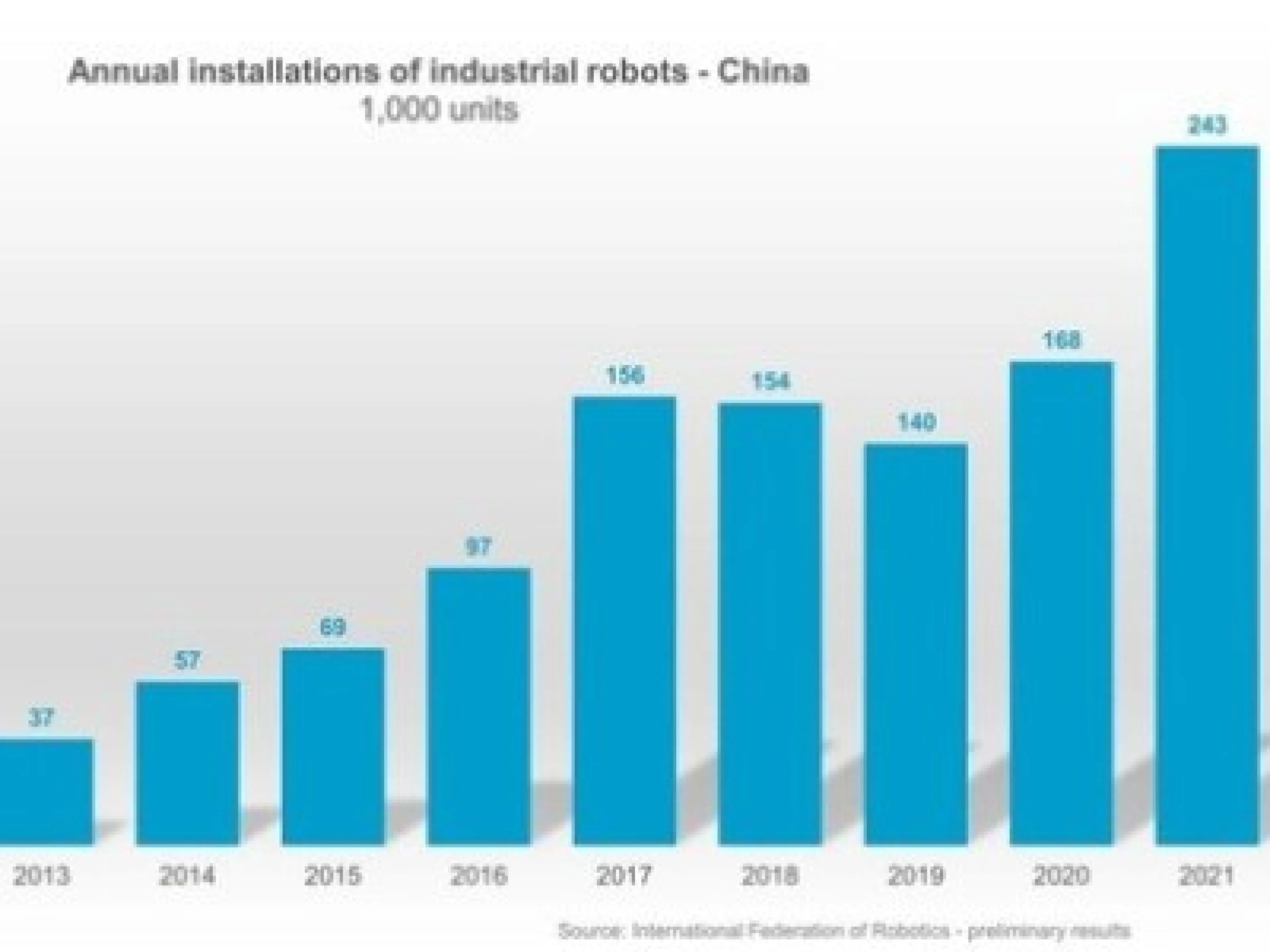
North America has reached a robot density of 204 units per 10,000 employees. The United States ranks near the top of the global list, followed by Canada and Mexico. Asia is experiencing more dynamic growth. The average robot density stands at 131 units but is growing significantly faster than in other regions. Countries such as South Korea, Japan, Singapore, and Taiwan are among the world’s leading hubs for industrial automation. China is seeing particularly strong growth in robot density, now reaching 166 units per 10,000 employees. At the same time, the country has the world’s largest installed base of industrial robots as well as the highest annual installation figures.
The frontrunners are countries with strong industries in electronics, automotive manufacturing, and mechanical engineering
The Republic of Korea has the highest robot density at 1,220 units per 10,000 employees. Since 2019, this figure has been growing there by around seven percent annually. The main drivers of this development are the highly automated electronics industry and automotive production, both of which rely heavily on industrial robotics. Singapore and Germany follow in the next positions. With 818 units, Singapore achieves a very high robot density, which is also attributable to the comparatively small number of employees in the manufacturing sector. At the same time, the country is making targeted investments in automated production structures.
Japan follows closely behind Germany with 446 units. As the world’s leading manufacturer of industrial robots, the country benefits from a close integration between robotics development and industrial application.
Other countries in the top group include Sweden, Denmark, and Slovenia, as well as the United States, Taiwan, and Switzerland. It is striking that countries with high robot density often have strong industries in the fields of electronics, automotive manufacturing, or mechanical engineering. These sectors are among the most important drivers for the use of industrial robots and significantly shape the development of automation.
Robot Density as an Indicator of Competitiveness
The trend in robot density shows that automation is increasingly becoming a decisive factor for industrial competitiveness. In addition to technological advances, economic conditions and industrial structures also play an important role. Particularly in growing markets, the demand for automation solutions is rising to efficiently meet increasing production requirements.