
As production facilities become increasingly digitized and networked, the need for a consistent, scalable, and robust data infrastructure is growing. Especially in existing facilities, it is crucial to reliably retrieve information from various controllers, sensors, and field devices and make it centrally available.
Against this backdrop, Phoenix Contact is expanding its IIoT framework within the "PLCnext Technology" ecosystem to include new connectors and the "Telegraf" app. This further simplifies data acquisition and transmission between the field level and IT systems. As an OT/IT gateway, the IIoT framework serves as the connecting layer between automation components and higher-level IT systems. The gateway is designed to capture various measured values such as digital signals, analog process variables, or energy data. This information is then consolidated in the Global Data Point Table (GDPT). There, all data points are converted into a uniform schema. For each data point, the device, name, value, unit, data type, and timestamp are stored, ensuring consistent and uniform data usage. Up to 1,000 data points can be processed in a single system, and this capacity can be expanded as needed.
Data acquisition in distributed production environments
The harmonized data can be read directly via OPC UA, REST API, or gRPC, or forwarded to databases, cloud platforms, or visualization tools via the "Telegraf" service. Engineering effort remains minimal, as the local bus of the "Axioline" I/O system is automatically read along with the connected modules. The modules are then automatically assigned to the appropriate connectors. Configuration is performed entirely via a web visualization and is automatically saved in JSON files. This simplifies updates and backups. Thanks to the open architecture of the IIoT framework and the "PLCnext Technology" ecosystem, users can implement their own connectors in IEC 61131-3 if needed. Extensive pre-built functions and blocks are available for this purpose, enabling straightforward implementation.
IIoT framework expansion with new connectors
With the new version 2025.0, the IIoT framework gains several additional connectors. The new "S7_Comm" connector enables direct communication with Siemens controllers from the "S7-300", "S7-400", "S7-1200", and "S7-1500" series. Various variables can be read directly from data blocks, regardless of their structure. Therefore, the "S7_Comm" connector is particularly suitable for modernization projects in which existing S7 controllers continue to be operated, but additional data must be provided for analysis, monitoring, or integration with IT systems.
Integration of heterogeneous controller landscapes
The new "EtherNetIP_Slave" connector complements the IIoT framework, particularly for users with Rockwell or EtherNet/IP-based machines. The connector allows a PLCnext Control to be connected as a slave to a scanner. Thanks to bit- and byte-precise mapping, even complex data structures can be accurately represented and transmitted. This results in a high degree of flexibility when integrating different machine architectures.
The generic Modbus connectors "GenericModbus_TCP" and "GenericModbus_RTU" expand the framework with a flexible option for retrieving data via Modbus/TCP or Modbus/RTU from a wide variety of devices. In this way, both simple sensors and complex field devices can be integrated into the network. The "Temperature" connector directly captures temperature values from Pt100 and Pt1000 sensors. It supports two-, three-, and four-wire sensors, allowing the integration of different installation and wiring configurations. The new "HART" connector expands access to smart process sensors. It allows the reading of analog measured values as well as the HART variables (PV, SV, TV, QV) of the sensors.
IIoT framework and scalable data pipelines
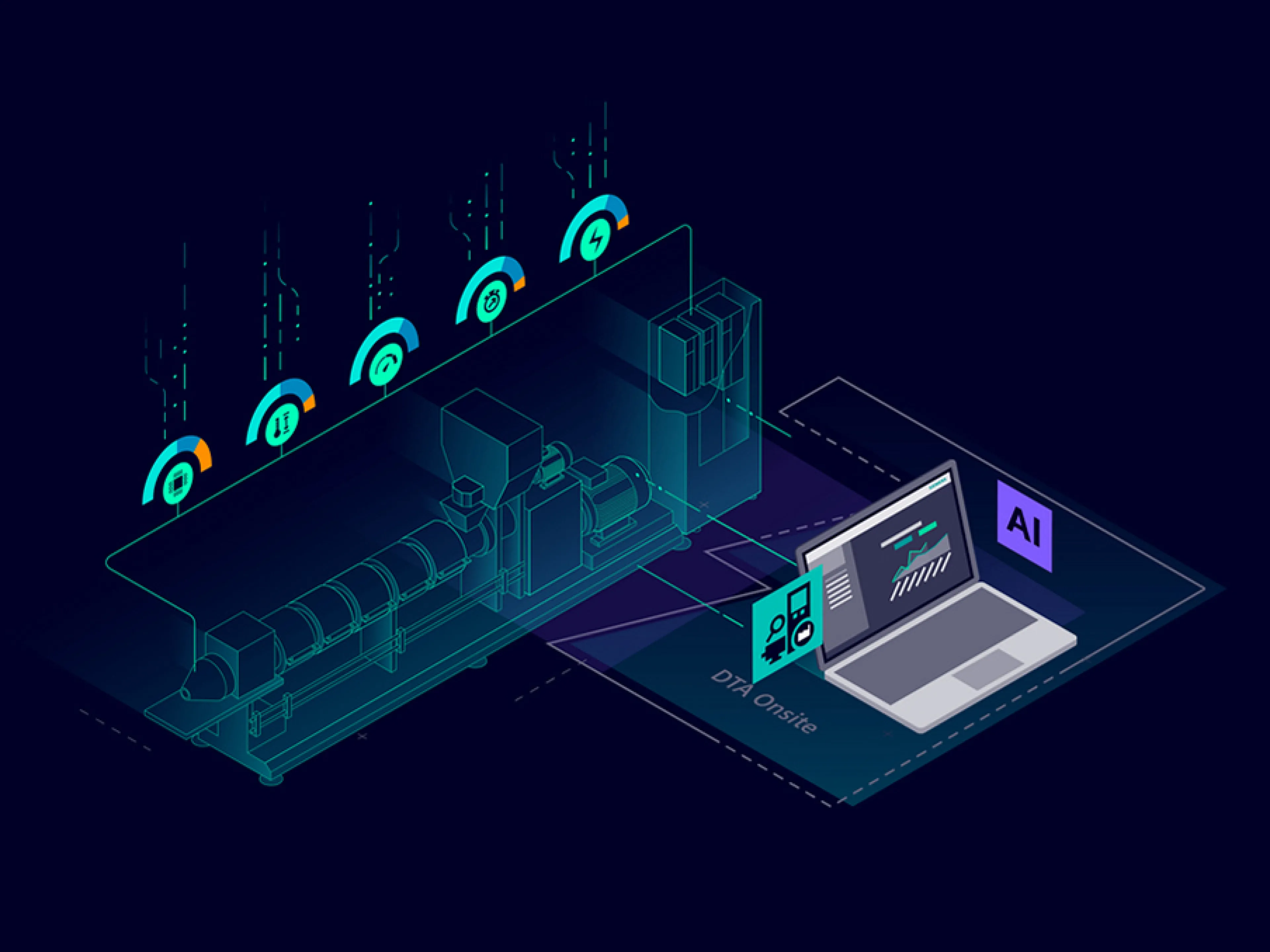
With the "Telegraf" app, the "PLCnext Technology" ecosystem gains a resource-efficient data agent that integrates into industrial IT and OT architectures. With more than 200 available plug-ins, "Telegraf" is suitable for simple machine connectivity as well as for complex data pipelines. The tool shows particular strengths on PLCnext Control controllers: raw data is buffered and preprocessed locally. This reduces the load on the controller and enables reliable forwarding of large data volumes to IT systems or cloud services.
Edge data processing and visualization
The integration of IIoT apps from the “PLCnext” Store creates a consistent edge data platform: "InfluxDB" serves as a time-series database on the controller, "Grafana" enables visualizations without external infrastructure, and "MariaDB" supplements the system with relational data storage. Together with the IIoT framework and the harmonized GDPT data structure, this creates a consistent, time-based data foundation. "Telegraf" extends this architecture with scalable data pipelines that aggregate and normalize data and make it available for monitoring tasks as well as machine learning processes such as anomaly detection or predictive maintenance.
IIoT framework for retrofit and brownfield integration
The new connectors in the IIoT framework enable a wide range of applications, particularly in brownfield environments. Existing S7 controllers, Modbus devices, and HART measurement points can be integrated into modern data landscapes without modifications to the control technology. This simplifies the retroactive implementation of energy monitoring, condition monitoring, and operational data collection.
Data-driven optimization based on unified data models
Combined data sources, such as energy meters, HART sensor values, or temperature measurements, provide a unified basis for consumption analysis, peak load assessment, and condition monitoring of systems. The "Telegraf" app expands these capabilities with flexible data pipelines at the edge. It filters, buffers, and aggregates data, then forwards it via more than 200 plug-ins to local databases, visualizations, or cloud platforms. This creates a scalable, consistent database that supports monitoring concepts and enables data-driven optimization approaches.
With the new connectors and the integration of the "Telegraf" app, the IIoT framework evolves into a unified data platform that covers the entire path from field devices to IT and cloud systems. Different sensors, controllers, and measurement points can be connected, harmonized, and evaluated centrally with reduced effort. The standardized GDPT ensures a uniform data foundation, while "Telegraf" provides flexible data pipelines for storage, analysis, and visualization. This results in a robust infrastructure that supports monitoring tasks as well as data-driven applications, including predictive maintenance. You can find Phoenix Contact at the 2026 Hannover Messe in Hall 27 at Booth G26.
Authors
Dario Bertoli and Thiemo Ludmann, both Solution Engineer at Phoenix Contact