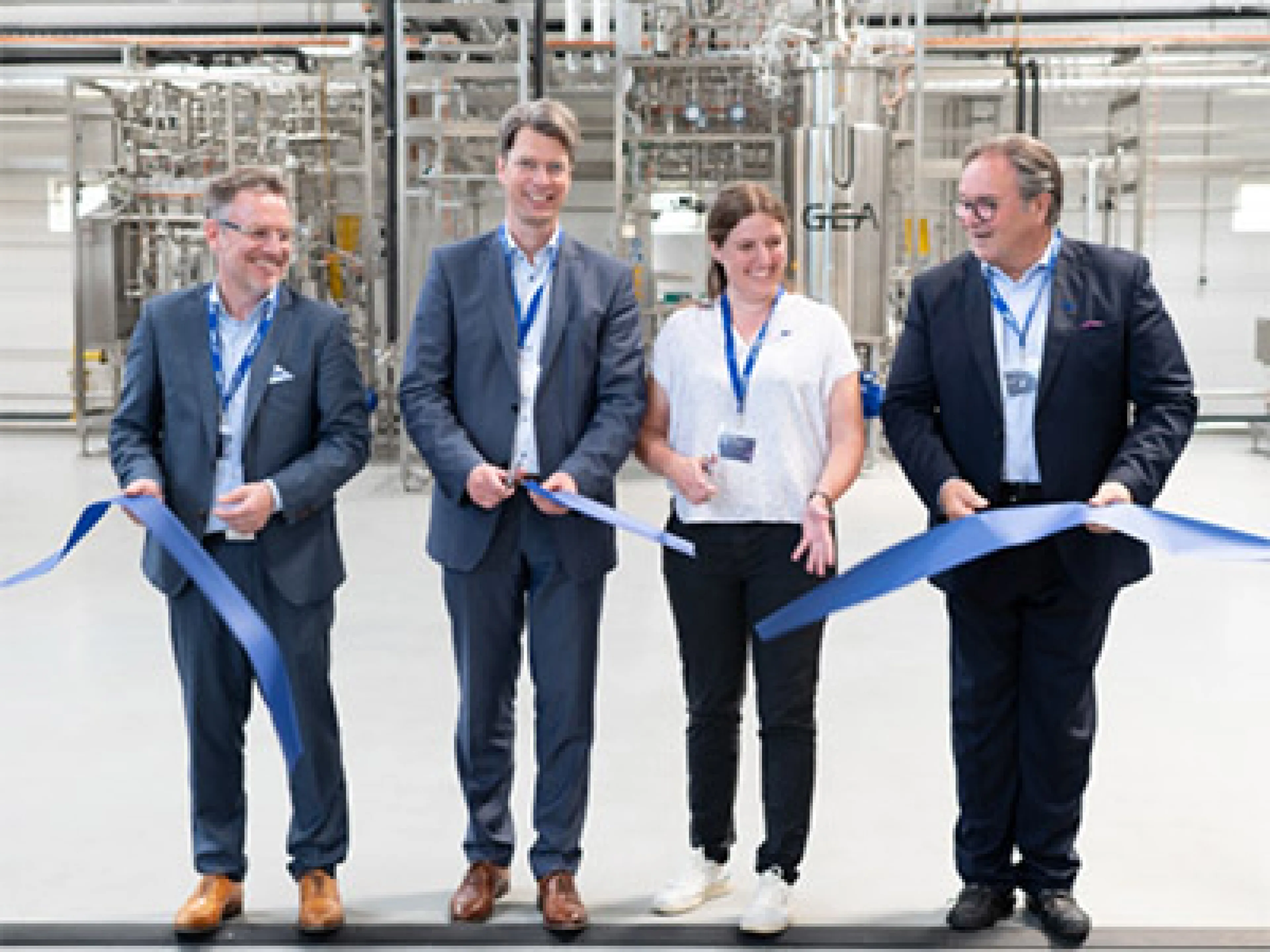

With an investment of €4 million, Gea is expanding its activities in the field of industrial biotechnology. The company has relocated its Application and Technology Center (ATC) from Hildesheim to Sarstedt in Germany and established a state-of-the-art technology center there. Food manufacturers, ingredient producers, and biotechnology companies can use this facility to scale up processes for precision fermentation, cell cultivation, and other biotechnological applications from the laboratory to the pilot scale. The center builds on the experience gained from three years of pilot operations and will in the future consolidate engineering, process development, and pilot infrastructure at a single location.
Industrial biotechnology requires the transition from the lab to practical application
Many biotechnological processes yield promising results in the lab. However, whether these result in an economically viable production process is only determined during scaling. This is precisely where Gea’s new technology center comes into play. There, companies can test their processes under realistic conditions and gain important insights for later industrial implementation.
The facility utilizes bioreactors with volumes ranging from 50 to 500 liters, as well as all upstream and downstream process steps, from media preparation through fermentation and separation to filtration, hygienic process control, and automation. This allows technical risks to be identified early on and investment decisions to be based on a robust data foundation.“New Food and biotechnology need places where you can find out whether a promising process can actually become a viable industrial application,” emphasizes Klaus Stojentin, CEO of Gea’s Nutrition Plant Engineering Division. “In Sarstedt, we bring pilot infrastructure and engineering expertise under one roof. That gives our customers a stronger basis for their next decision.”
Gea Technology Center Combines Engineering and Pilot Infrastructure
With the move to Sarstedt, the Application and Technology Center is now directly adjacent to the site’s existing engineering expertise. Already, around 200 employees work there in the areas of engineering, automation, sales, and service. With the arrival of the Technology Center, the number of employees will grow to around 240. This creates a seamless development process for customers. From initial pilot trials to the planning of an industrial production facility, the same team of experts is available to them. This shortens coordination channels and facilitates the transition of new processes to an industrial scale.
Industrial biotechnology opens up new possibilities for the food industry
Precision fermentation and cell cultivation are often associated with alternative protein sources for meat, fish, or dairy substitutes. In fact, the range of applications extends much further. Using biotechnological processes, it is possible to produce, among other things, enzymes, amino acids, vitamins, flavors, and other functional ingredients that are used in numerous food and beverage applications. Such processes are becoming increasingly important for manufacturers. They open up additional sources of raw materials and can help make supply chains more resilient or facilitate the development of new product concepts. At the same time, demands for process stability, cost-effectiveness, and regulatory compliance are rising.
Pilot plants provide planning certainty for investments
The biggest challenge often lies not in the fermentation itself, but in safe scale-up. It is only at the pilot scale that it becomes clear whether a process can be consistently replicated and whether the desired product quality is achieved. “A good lab result creates interest. A solid process creates confidence. And sometimes the most valuable outcome of a test run is a clear no, because a process isn't stable enough yet, or the cost structure simply doesn't hold up. Learning that early can save a company a lot of time and capital,” says Frederieke Reiners, Head of New Food & Biotech at Gea. For food manufacturers and ingredient producers, pilot plants thus offer an important intermediate step before larger investments in production capacity are made.
Sarstedt Becomes a Center of Excellence for Industrial Biotechnology
With the expansion of the site, Gea is strengthening its position as a development partner for biotechnological production processes. The technology center combines pilot infrastructure with engineering expertise and helps companies evaluate new processes more quickly and thoroughly. At the same time, the investment underscores the growing importance of industrial biotechnology for the food industry. As precision fermentation and other biotechnological processes gain in importance, facilities where processes can be developed and validated under real-world conditions become increasingly vital.